Every December, readers share their reading wrap-ups: stacks of spines, favorite covers, total pages and the one book they'll never stop talking about. A wrap-up is fun to share, but its real value is personal. It shows you what you actually enjoy, which makes next year's reading better. This guide covers how to gather your data, what to calculate, which favorites to pick and how to turn it all into something you'll want to keep.
Monthly or yearly?
You can wrap up at any interval:
- Monthly wrap-ups are quick (10 minutes) and keep your memory fresh. They also make the yearly one much easier.
- Seasonal wrap-ups suit readers who read in moods: a cozy winter, a romance-heavy summer.
- Yearly wrap-ups are the big one: your whole reading life for twelve months in one page or one image.
If you've never done one, start with this year's yearly wrap-up, then try a quick monthly one in January.
Step 1: Gather your list
You'll need a list of the books you read this year. If you kept a journal or an app, you're set. If not, rebuild it from:
- Your shelves and nightstand (what's been moved recently?)
- Your library account's borrowing history
- Your e-reader and audiobook libraries
- Order confirmations in your email
- Photos on your phone of books, reading spots and bookshop trips
- Messages where you recommended or complained about a book
Don't worry about being perfect. A wrap-up with 90% of your books is still a great snapshot. For each book, note the title, page count, genre, the month you finished and a quick star rating.
Step 2: Work out your stats
Numbers are part of the fun. Here are the most interesting ones and how to find them:
- Total books: just count.
- Total pages: add up the page counts. Divide by 365 for your average pages per day.
- Hours read: a rough estimate is total pages divided by your pages per hour. The reading speed test gives you your pace.
- Average rating: add up your stars and divide by the number of books.
- Top genre: tally books by genre. The result is often a surprise.
- Busiest month: the month with the most finished books.
- Longest and shortest reads: by page count.
- Formats: how many were paper, ebook or audio.
Prefer not to do the math? Our free Year in Books maker does all of it for you. Add your books (or paste a whole list), and it builds a shelf of spines sized by page count, then shows your pages, hours, average rating, top genre, busiest month and a reader title. It makes a story-size and post-size image to share, and nothing leaves your device.
Step 3: Pick your favorites (the "awards")
Handing out awards is the best part of a wrap-up. Pick a few categories and choose one book for each:
- Book of the year
- Biggest surprise
- Best character
- Best ending
- Most quotable
- Best cover
- Best comfort read
- Most likely to be recommended to everyone I know
- The book that took me longest to recover from
- The one I wish I'd skipped (optional, but honest)
Step 4: Look for patterns
Now step back and ask what the year says about you as a reader. This is where a wrap-up becomes useful:
- Which genres or tropes got your highest ratings?
- Did long books or short books make you happier?
- When did you read most, and what was happening in your life then?
- Which recommendations worked best: friends, bookshops, lists, random finds?
- What did you stop reading halfway through, and why?
If the patterns point to a type, our reader type quiz is a fun way to confirm it and get ideas for next year.
Step 5: Make it look good
A wrap-up can be as simple or as creative as you like:
- A journal spread: a "year in books" page with your stats, awards and a small drawing of your shelf.
- A shareable card: the Year in Books maker creates one in a couple of minutes.
- A book stack photo: gather every physical book you read and stack them by color or month.
- A streak calendar: if you tracked your reading days with the reading streak tracker, print your year at a glance.
- A letter to yourself: a few paragraphs about your reading year to open next December.
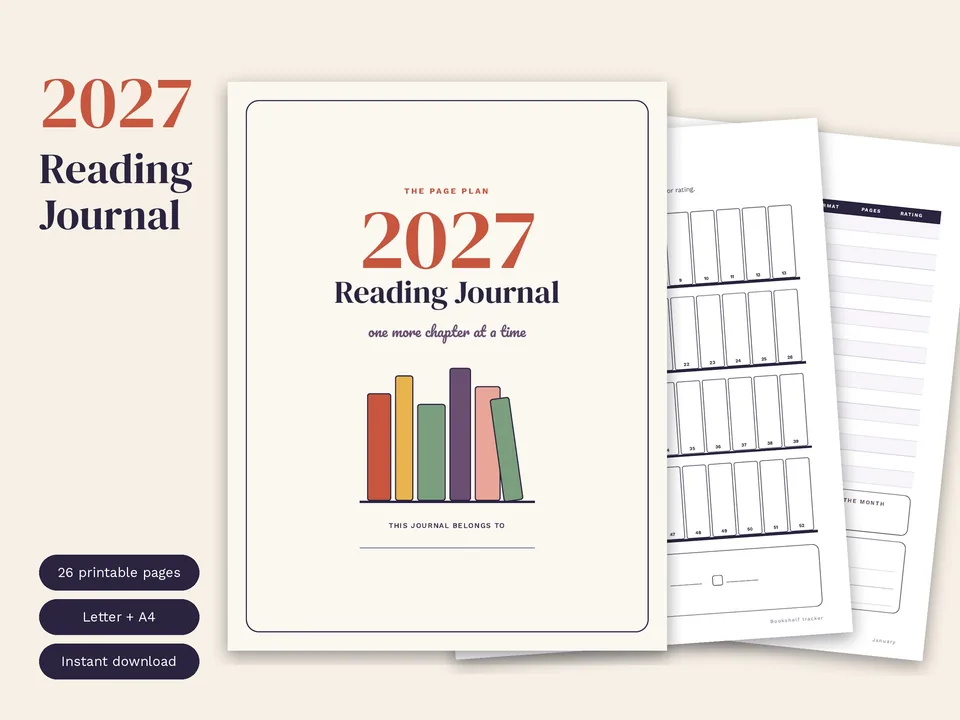
Track next year from day one.
The 2027 Reading Journal has a 52-book bookshelf, monthly logs and a "my year in books" page, so next December's wrap-up is already done.
A monthly wrap-up template
Copy this into your journal at the end of each month:
- Books finished: ___ · Pages read: ___
- Book of the month: ___
- Best moment or quote: ___
- Did not finish: ___
- Most-read genre: ___
- Next month I want to read: ___
Twelve of these make your yearly wrap-up almost write itself. For more ideas, see our 100 reading journal prompts.
Step 6: Turn it into next year's plan
End every wrap-up by looking forward. Use what you learned to set one reading goal, one fun goal and one habit for the new year. Our guide on setting a 2027 reading goal walks through it step by step, and the reading plan calculator turns your goal into pages per day.
Share it (or don't)
Sharing a wrap-up is a great way to find new books: friends reply with "if you loved that, try this", and your book club gets a ready-made discussion. If you share online, a few ideas make it more fun: lead with your book of the year, add one surprising stat (your busiest month or your longest read), and end with a question like "what should I read first next year?". If you'd rather keep it private, that's just as valuable. A wrap-up tucked into the back of your journal is a lovely thing to reread in five years, when you've forgotten what you were reading during that snowy January.
Tips for a better wrap-up
- Track as you go next year. Log each book the day you finish it and your wrap-up is 90% done.
- Don't compare. Someone else's 150 books doesn't make your 12 any less of a year.
- Count what you want. Audiobooks, rereads, novellas and books you didn't finish are all fair game if you want them.
- Celebrate. Treat yourself to something small for the year you had. A new bookmark, a special edition or a bookish mug all count.
Build a shelf of every book you read this year and get a gorgeous, shareable reading wrap-up card.
Pages, top genre, longest book, five-star favorite, on a shelf of spines you design. No sign-up.
Build my shelfQuestions people ask
What is a reading wrap-up?
A reading wrap-up is a summary of what you read over a month, season or year: your books, stats such as total pages and top genre, your favorites and what you learned about your reading.
How do I find out how many pages I read this year?
Add up the page counts of every book you finished. The free Year in Books maker adds them up for you and also estimates hours, average rating, top genre and your busiest month.
What if I didn't track my reading this year?
Rebuild your list from your shelves, library history, e-reader and audiobook libraries, order emails and phone photos. A list that's nearly complete still makes a great wrap-up.
When should I do my yearly reading wrap-up?
Late December or the first week of January. Many readers finish the year's last book first, then use the wrap-up to set next year's goals.