Every January, readers everywhere set a goal. By March, plenty of those goals feel like homework. The problem is rarely the reader. It's usually the goal: a number picked out of thin air, with no plan behind it and no room for real life. This guide walks through a better way to set your 2027 reading goal, one you'll still enjoy in November.
Step 1: Look back before you look ahead
The best predictor of next year's reading is this year's reading. Before you pick a number, spend fifteen minutes answering these:
- How many books did I finish this year (roughly is fine)?
- Which months were busy for reading, and which were slow? Why?
- Which books did I love most, and what did they have in common?
- Did I finish anything I didn't enjoy just to "count" it?
If you didn't track this year, add up what you can remember, or use our Year in Books maker to list them and see your pages, top genre and busiest month at a glance. Our guide to making a reading wrap-up has more reflection questions.
Step 2: Choose the kind of goal that suits you
A number of books is only one option. Pick the style that matches what you actually want from reading next year:
- A book count. Classic and motivating if you like seeing a total go up. Best for readers with a steady pace.
- A page count. Fairer if you love long fantasy or big classics, because a 700-page book counts for what it is.
- A time goal. "Read 20 minutes a day" or "read four evenings a week". Great for busy seasons and for rebuilding a habit.
- A variety goal. "Try six new genres" or "one classic a season". Perfect if you read plenty but always the same thing.
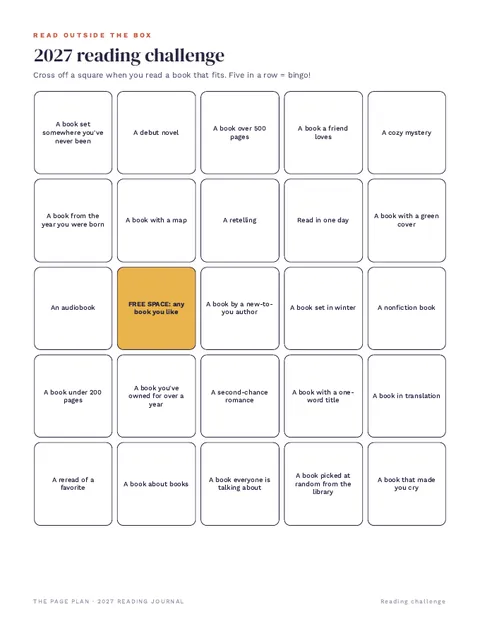
- A challenge. A list of prompts or a bingo card. See our 60+ reading challenge ideas or deal a free trope bingo card.
- A "less" goal. Buy fewer books, read more of the ones you own, or finish series you started.
Many readers combine two: one number and one fun goal. For example, "24 books, including six from my own shelves".
Step 3: Find your number from your real pace
If you go with a number, base it on how you actually read, not on how you wish you read. Here's a simple formula:
- Estimate your average book length (for many readers, somewhere around 300 to 400 pages).
- Estimate how many pages you read on a normal day, counting the days you don't read at all.
- Multiply your daily pages by 365, then divide by your average book length.
For example, 20 pages a day is 7,300 pages a year, which is about 24 books of 300 pages. Thirty pages a day is roughly 36 of those books. Our free reading plan calculator does this in both directions: enter a goal and see pages per day, or plug in your pace. Not sure of your pace? The reading speed test takes a minute.
Then do one more thing: take your number down a notch. Life happens. A goal you beat feels much better than a goal you miss by three books.
Step 4: Break it into months and weeks
A yearly goal is too far away to feel real. Break it down:
- 24 books a year is 2 a month, or one every two weeks or so.
- 36 books a year is 3 a month.
- 52 books a year is 1 a week.
Now plan around your calendar. If December is always hectic and summer holidays are reading heaven, front-load or back-load accordingly. Write your monthly targets in your journal or on a sticky note by your bed.
Step 5: Build the habit, not just the goal
Goals tell you where you want to go; habits get you there. The readers who hit their goals usually have a reading "slot": ten pages with morning coffee, a chapter at lunch, twenty minutes in bed. Pick one slot and protect it. The free reading streak tracker turns those small sessions into a visible streak, which is surprisingly hard to break once it gets going. For more ideas, see how to read more books.
Step 6: Make a TBR, but keep it loose
Write down 10 to 15 books you're excited about for the year: a few new releases, a few from your own shelves, a series to finish, one big "someday" book. Leave plenty of space for mood reads. A TBR is a menu, not a contract.
Not sure where to start? The what should I read next quiz suggests tropes and sub-genres that match your reader type.
Step 7: Plan for slumps now
Every reader hits a slump. Decide now what you'll do when it happens, so it doesn't derail the year:
- Switch to a short book, a novella or a graphic novel.
- Reread an old favorite.
- Try an audiobook for a few weeks.
- Give yourself permission to quit any book after 50 pages.
Step 8: Check in every month
On the first of each month, spend ten minutes looking at what you read, what you loved and whether your goal still fits. Adjusting a goal mid-year isn't cheating. It's the whole point of having one you can live with. If you're way ahead, raise it or add a challenge. If you're behind, lower it without guilt.
A simple 2027 goal-setting template
Copy this into a notebook or the goals page of your journal:
- My 2027 reading goal is: ______ books / pages / minutes a day
- My fun goal is: ______ (a genre to try, a series to finish, a challenge)
- My reading slot is: ______ (when and where I'll read most days)
- Three books I can't wait to read: ______
- When I hit a slump, I will: ______
- I'll celebrate hitting my goal by: ______
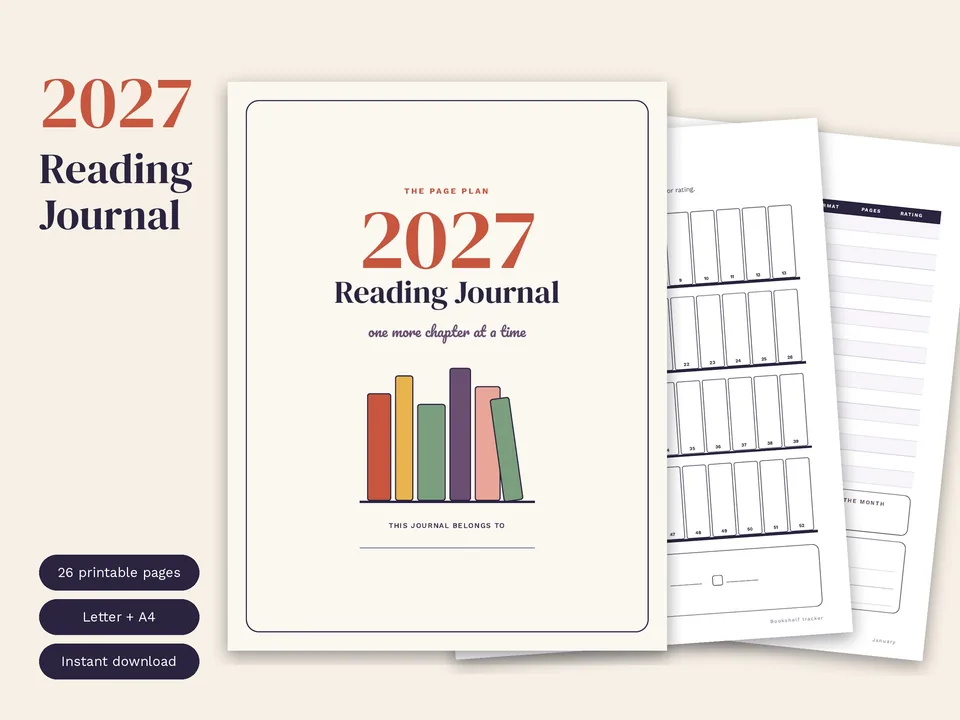
Put your 2027 goal on paper.
The 2027 Reading Journal has a goals page, a 52-book bookshelf you color in, twelve monthly logs and a challenge bingo, so every check-in takes two minutes.
Treat yourself along the way
Milestones deserve a little celebration: a new bookmark after your tenth book, a special edition at the halfway point, a cozy new mug when you hit your goal. Small rewards make the whole year feel like a game you're winning. Our bookish gift shop has a few ideas if you want to treat yourself.
Pages a day for a yearly goal or a book club deadline.
Our free reading plan tool works it out in seconds. No sign-up.
Open the reading plan toolQuestions people ask
What is a realistic reading goal for a year?
Base it on your real pace. About 20 pages a day adds up to roughly two average-length books a month, or around 24 a year. Start slightly below what you think you can do and raise it later if you're ahead.
Should I set a reading goal by books or by pages?
Books are simple and motivating. Pages are fairer if you love long books, because one 700-page fantasy counts for what it is. Time goals, like 20 minutes a day, are best for building a habit.
Is it OK to change my reading goal during the year?
Yes. A reading goal is there to help you enjoy reading more. Raise it if you're ahead, lower it if life gets busy, and don't feel guilty either way.
How many pages a day do I need to read 52 books a year?
For books around 300 pages, about 43 pages a day, or about 50 pages a day for 350-page books. The reading plan calculator works out your exact number.